Physical Address
304 North Cardinal St.
Dorchester Center, MA 02124
Physical Address
304 North Cardinal St.
Dorchester Center, MA 02124
Fiber internet — also called fiber optic internet — uses thin glass or plastic threads to transmit data as pulses of light. Unlike traditional copper cables used by cable and DSL providers, fiber can carry enormous amounts of data across vast distances with virtually zero signal degradation. This is why fiber internet speeds consistently outperform every other residential broadband technology available in the United States today.
When you subscribe to a fiber internet plan, data travels from your ISP’s network directly to your home through a dedicated fiber line. There are two main configurations: FTTH (Fiber to the Home) and FTTC (Fiber to the Curb). FTTH delivers the best performance because the fiber connection runs all the way into your residence — no copper bottleneck at the last mile.
The debate between fiber vs cable internet used to be a close one — cable infrastructure is widespread and has improved over the years. But in 2026, the gap has widened significantly. Here’s how they stack up across every dimension that matters to a modern American household:
| Factor | 🔵 Fiber Internet | 🟠 Cable Internet | Winner |
|---|---|---|---|
| Download Speed | Up to 5–7 Gbps | Typically 100–1,200 Mbps | Fiber ✓ |
| Upload Speed | Symmetrical (equal up/down) | Often 10–50 Mbps (asymmetrical) | Fiber ✓ |
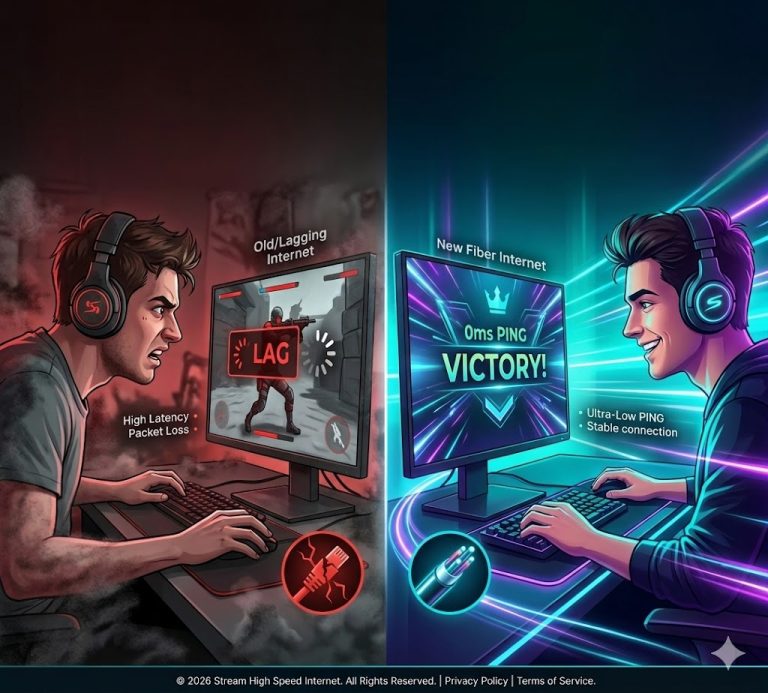
| Latency / Ping | 3–10 ms | 20–50 ms | Fiber ✓ |
| Reliability | Highly stable, not shared | Shared node — slows at peak hours | Fiber ✓ |
| Price | $45–$80/mo | $50–$100/mo | Fiber ✓ (better value) |
| Availability | 47% of US homes (expanding fast) | ~90% of US homes | Cable ✓ |
| Data Caps | Rarely enforced | Common (1TB–1.2TB limits) | Fiber ✓ |